NATURALLY THINKING

By Margaret Waddingham

Articles published in the Caundler Magazine
My liking for starlings is limited to admiration of their wonderful mumerations, and there, I’m afraid, it ends.

In my garden they descend on the window feeder and finish off the meal worms which are there for robins and a pair of blackbirds.
The starlings dive in, sometimes trying to balance in the limited space in such numbers that the worms disappear in a matter of minutes, or worse, pulling the feeder off the window altogether.
Sorry Starlings, but in spite of your beautiful oil-on-water coloured plumage, I’m put off by your greed, your gimlet beaks and the rather evil look in your eyes.

The Blackbirds have an interesting pattern of behaviour that I’ve not noticed before.

Often the male arrives first, perches on the handrail of the ramp within a couple of feet or so of the window feeder, and clucks.
Then he flutters onto it and begins to feed, whereupon the female dives in and he immediately flies off.
Occasionally they do it in reverse and the female arrives first and clucks for a moment.
I suspect that he clucks back but I can’t hear through the double glazing.
On one occasion she sat and clucked for a long time before he arrived.
Does his near presence make her feel safer I wonder?
The Robins, incidentally, are conspicuous by their absence.

The trees seem to have behaved very oddly this autumn

Or is it that I have just never noticed it before?
In spite of having no frosts to speak of, and no high winds, both of which would normally help to strip the trees bare, leaves are fluttering down anyway.
The large ash tree in my neighbours’ garden lost them in a most orderly fashion, starting on one side and working its way through until the whole tree had become denuded, whilst a little tree in my own front garden suddenly released them almost overnight.
The large acer in the front of another neighbours’ garden took almost precisely three weeks to give its leaves up completely.
Now at last we have some wind and brighter, cooler air has come in so the large cherry, also in my front garden, has decided to join in with this disrobing fray.
The lawn is now carpeted in the rich colours of autumn – bronze, and gold and all shades of red.

Unusual Weather

If we had had a few high winds, plus some sunshine, it might have helped the farmers but after a record 18 months or more of rain, fields are saturated.
Farmers have struggled to get in the last of the maize harvest, making the most of any breaks in the weather, but much of the ground is too saturated even to sow winter crops.
As it was, we had been trapped beneath a gloomy blanket of cloud caused by high pressure for almost two weeks with no great change from day to day.
This is unusual for this time of the year and it was a welcome relief to one and all when at last it lifted and turned a few degrees colder.
We even saw some sun now and then – we had almost forgotten what it looked like.
Maybe pests will be struck down soon as the forecast for the coming week is for much colder weather, and hedgehogs might at last have a chance to sleep.

I have recently been reading the diary of one of my daughters

It was written in the early 1970’s whilst she was at primary school at the age of 10 and 11.
Apart from all the things she and her sister and their friends got up to, she recorded snow, not only before and after Christmas but also in March and April.
Snow now is almost a distant memory, although we did have some spectacularly thick frosts just two or three years ago when my other daughter took a video of a walk in some woods on Bulbarrow.
This is accompanied by a musical tinkling of frost falling from the trees.
It was a lovely sound and one I have never heard before.

In spite of everything though, both gardens and countryside are beginning to shut down.

Ivy is in flower and there are berries on the holly if you know where to look.
There are some spectacular fungus around and, both daughters assure me, leaves are at a satisfyingly shuffling stage as I write this.

Scents of the Season

Apart from these obvious sights of late autumn, I do love the scents of the season all around me, whether I am in the garden or further afield on Genevieve.
Each season has its special smell and that of Autumn is of rotting leaves (much better than it sounds), damp earth and sometimes even wood smoke.
Quite soon it will smell of winter, hopefully of the sharp scent of frost and clean, fresh air.
And very soon, inside, there will be that very particular special one – that of spices, of puddings boiling and rich fruit cakes baking.
May I wish every one of you a very, very Happy Christmas
Read More
Because of a slight mishap between the fridge, a jar of coffee and my left arm, I have only been out on Genevieve once in the last few week.

That trip didn’t last long as it was more uncomfortable than I had expected, but I got round The Wheel and it was quite satisfying.
Several meadow brown butterflies were around, all looking rather dingy after the brightness of the red admirals which were visiting my garden that same day, but they were fluttering around the damp and flattened September grasses and it was nice to see them.
There also seemed to be quite a good crop of blackberries, but many of these were small and very pippy-looking and, I am assured that even those that look promising have little flavour – a result of the wet season.

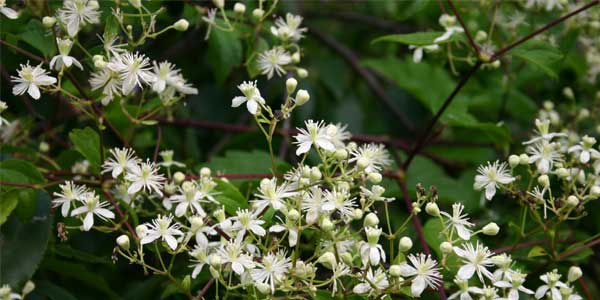
Most of the hedges round here are clothed with wild clematis.

The seeds of their green and white flowers have now ripened and each one of them now bears shaggy hairs that are borne away on the wind.
By now it looks as though someone is airing pale grey blankets on these hedges.
It is a plant that likes chalk or limestone and as the soil round here seems to vary almost yard by yard, this explains why all the hedges are not festooned.
It is known as Traveller’s Joy simply because of its beautiful shaggy hairs, even though I never think it looks particularly joyful as it approaches the end of the year, by which time most of the blankets seem to take on a very dull grey appearance.

Fleabane and Black Bryony

I noticed that there were several clumps of fleabane, looking a little less bright that usual, and beaten down low by rain. These usually bright, daisy-like flowers were so known because they were used to repel fleas. Owing to a diminishing supply of these nasty little insects, I was always pleased to find satisfyingly large big sweeps on our moor in Devon, as I did here on Lydlinch Common.
Here and there sealing wax red berries of black bryony decorated the hedges.
These are avoided by birds and mammals as they are a very powerful poison, and, if odd little snippets of information appeal to you, this is the only member of the yam family that we have in this country.

Meanwhile, in my garden, I have been noticing worms, or rather, what they do.

When I was little, my father used to draw pictures for me of a worm propped up on a walking stick, hat on its head and pipe in its smiling mouth.
I don’t think I’ve ever seen a worm with a mouth, with or without a pipe.
Looking it up in a book though, it does seem to have a very small sort of mouth piece which it uses to pull a leaf gradually underground.
I have watched this operation from the top, ie., with the leaf gradually disappearing from view.
It takes a long time but it is interesting if you have quite a lot of it to spare.

Of all autumn berries, the spindle is my favourite.

From such insignificant beginnings of small, greenish flowers, come vivid autumn fruits, their bright pink, four lobes splitting to reveal the clashing orange-coloured flesh.
It is poisonous and a violent emetic and used to be used as a purgative long ago, or else baked and powdered to be rubbed into the hair to get rid of head-lice.
It doesn’t do sheep and goats much good, but birds love them and they seem to be the main broadcasters of its seeds.
Many hundreds of years before the invention of the first spinning wheel, the spindle’s thin, strong stems were used by women to spin raw wool.
They twirled a stick of this wood between their fingers and called it a ‘spindle‘.

Spindles such as these have even been found on prehistoric sites.

Centuries later, its smooth hard, wood was found to be ideal for pegs, knitting needles, skewers and even toothpicks and these days bushes of them are often found in ancient hedgerows or woodlands.
Brian and I used to walk to Rue Lane where we knew there was one and we would rob it of a few of its lower branches to take home to put in a copper jug in the fireplace.
Now I have one, very prolific bush in my own garden.

Glancing through one of my Naturally Thinking notes of 2011

Glancing through one of my Naturally Thinking notes of 2011, I read that the average five acres of grassland contains about 1 ton of insects.
What’s more, the number of spiders in 1 acre of hay meadow contains 2.25 million of them and as each spider eats approximately two insects per week, it works out that they consume a total of around 108 million insects, give or take a few that they missed.
I don’t know where I got these fascinating facts from, which is a shame because I would like to compare them with the facts that we have for the last few years when numbers have fallen so dramatically.

Read More
Think back to the summers of not long ago.

When the buzzing and hum of insects and the strident sound of grasshoppers and crickets were the background orchestra of a warm, summer’s day that accompanied you through fields and lanes and gardens.
They were the sounds of my childhood, when my parents took us for hikes into the countryside.
Later, they were with me on walks on the downs of Surrey, on the moors of Devon and our lanes here, and in our gardens wherever we were.
More recently, on my rides on Genevieve they accompanied me.
But has that wonderful sound gone for ever?
The lack of them was the subject of a rather sad programme I heard on the radio one day recently.
Genevieve and I headed down Rowden Lane and searched amongst the hogweed, meadowsweet and nettles on the verges for some trace of them.

Hogweed usually hosts many insects and I found at least a few heads that were doing just that.

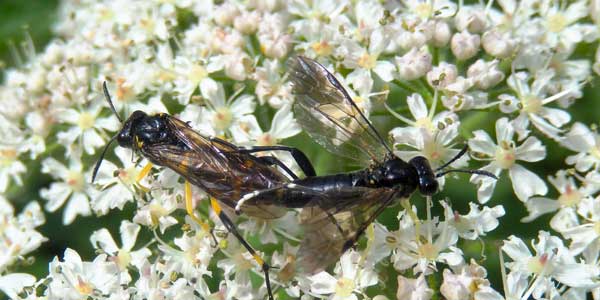
There was even some noise around them from the buzz of flies of all shapes and sizes, including the iridescent green familiar one, wild bees and bee flies, small wasps, hover flies and small beetley things, hardly any of which I recognised and which made me realise that I know nothing at all about the insect world.
I wonder whether I have enough years left to even begin to learn what’s what and which is which?
The only one I really knew in Devon was the orange coloured soldier beetle, but there were certainly none of those around.
However, I was greatly heartened by Janie telling me that she had seen soldier beetles AND heard grasshoppers amongst the wealth of wild flowers she had found on one of her many walks near here.
Down the lane that is my hunting ground, the abundance of creamy, fluffy heads of meadowsweet and flowering nettles had benefited from all the rain we have had.
They had looked miserable in the dry weather for the past few years, unlike the hogweed which will put up with almost anything.
The lovely, meadowsweet, with its dual scents of sweet almond and cucumber, should be host to no end of small beetles whilst the nettles provide everything a tortoiseshell butterfly could wish for on which to lay its eggs.
Here’s a bit of useless information – meadowsweet was once strewn on floors in front of a bride so that the air would smell sweet before her for all her life.

Purple Loosestrife, Vetch and Chicory

On a small patch of ground that is slightly higher than that around it, there was a patch of purple loosestrife.
This surprised me as I had thought it only grew in ditches or beside water, but on talking about it with Janie, I learned that they have a long root, so it probably has its feet in water, even in its present position.
There are several varieties of vetch out, largely purple but one yellow, which is the meadow vetchling, a plant that scrambles through meadow lands and rough grass.
The purple one is a common vetch – such a shame any flower has the prefix, ‘common’ because that word conjures up the wrong image for something as lovely as a flower.
This one also scrambles around and can grow quite tall, even attempting to clamber through hedges at times.
I was also delighted to see two short, stumpy blue chicory heads by the bridge.
I had feared that the tall, sturdy plant of it that had delighted me over the past few years, had vanished with the floods, but it seems to have left a good inheritance behind.

Great pleasure from a hare

Just as I got to the entrance of a field where I usually turn round, a hare suddenly ran past the inside of the gate and up the edge of the field.
That really did give me a great deal of pleasure.
Several people had told me that they had seen them, but they are on foot and walking over fields, unlike Genevieve and me who have to stick to the roads.
I watched it until it was out of sight, and I was once again mesmerised by the speed at which it travelled. I love them and am pleased that they are increasing in numbers, but I wonder whether farmers share my enthusiasm?
I believe they can seriously damage cereal crops.

Nearer to home, I have unwelcome neighbours.

A pair of magpies seem to have taken a liking to the trees in my neighbour’s garden and are paying visits to mine. These birds, although handsome in their glossy black and white livery, are large and hassle small birds.
They also have a nasty habit of raiding nests and dining on fledglings.
The woods are the place for these raiders, not gardens and I keep my fingers crossed that something will make them realise this.
One of the carers who visits me is Australian and thought I was very lucky to have them as they have such a beautiful song.
When I pointed out that I don’t find their harsh cackle in the least beautiful, she played me an Australian one on her phone.
No comparison – it was like hearing the difference between a nightingale and a frog.

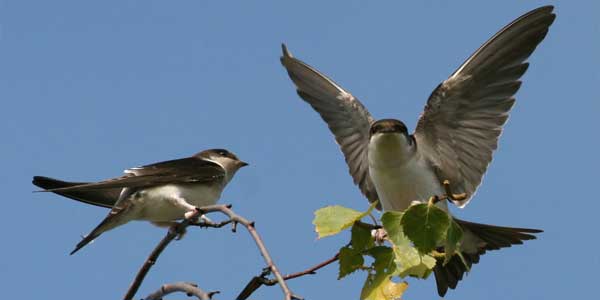
I think most of my house martins have fledged.

I see little flocks of them swirling round and round the house, in training to feed and fly the long distance to warmer climes.
The trouble is, there is often a second brood, which is always a bit worrying, because I’m never sure whether they will be strong enough to make the journey.

Forgive me, but I’m now going into rant mode on something that has been puzzling and infuriating me for some time.

As large numbers of our small song birds are decreasing at such an alarming rate, isn’t it time to do something more about one of the avoidable hazards they face on their way back to countries such as ours for the summer, that of netting and trapping?
This was widely practised across Europe, but a law to prohibit this was passed and agreed by the European Union, but is continually broken by Malta, France, and Italy, to name just three.
They seem to do it for various reasons; Malta, for instance, because it uses small birds as decoys for larger ones.
The countries involved are responsible for the trapping of so many of the birds that are declining rapidly, including thrushes, turtle doves, plovers and nightingales, and it makes no sense to me at all that they are allowed to get away with it. If a law is signed and agreed, why can’t it be upheld?

Ending on a positive note

I have slow worms in my garden, and a multitude of frogs of all sizes and ages, newts and lots of insects and butterflies and an assortment of birds, all
buzzing or flying around, presumably enjoying it as much as I do.
Good.
I must be doing something right!

Read More
I thought he had knocked the old nests down but he assured me he hadn’t, instead he had carefully painted round each of them.

The little birds were here within two weeks of his finishing the job and promptly added a fifth to their terrace. Four of these high desres are now occupied as is one at the front.
Although they make an awful mess over the window sills and roses, I’m quite willing to put up with that for the pleasure they bring.
I watch them several times a day swooping after high flying insects, then getting slightly confused about which nests they take them to.
I’m sure that sometimes the wrong resident receives a meal from an unexpected quarter, but there is more often a cross ‘get out’ type screech that greets them.
We have had House Martins sharing our house almost ever since we arrived here and feel very honoured to receive them.
Nearby daughter has also been similarly honoured, but this year none have arrived and she is both sorrowful and indignant at her loss.
Apart from anything else, she misses their chatter which always means summer (hopefully).
It does make you wonder whether something has happened to that particular family and their offspring that have been returning to her house for years.

My wild flower species count has reached 35, which includes a false oxslip but no orchids.

I know this total would be far greater if I could train Genevieve to safely cross fields and woods but verge sides are better than nothing.
My count this year includes wild garlic (ransoms) which I hadn’t found anywhere near a verge before.
There is a section of hedge at the top of Drove Lane that seems to divide into two, and there they were, a small profusion of them filling the air with the familiar garlicy scent. The false oxslip I was pleased with.

False oxslips

Half way along Rowden Mill Lane, where the cowslips are pleasingly spreading year on year, there is something which I had been puzzling over for a few years.
Just one plant in the middle of the thickest growth of cowslips, there is a single plant which looks like a cowslip gone wrong or perhaps a bit like cultivated polyanthus.
This, I have found, is a false oxslip.
It is a hybrid between a primrose and cowslip where the two grow together.
I wonder whether it will ever multiply because I first began to notice this one about three or four years ago and there is still only the one plant.

At the first gateway down this lane, I saw a sight which took my breath away.

It was a field of golden buttercups and white dandelion heads.
The land rises slightly, and along the ridge against the skyline, there seemed to be a line of young trees.
They weren’t trees of course, but grasses, perhaps cocksfoot though I can‘t be sure as they were too far away.
The sun shone and there was a slight breeze over the field and the sight was one that will be imprinted in my mind for weeks or months to come.

Has it really stopped raining?

We have just had the warmest sunny days for months with the resultant luxuriant growth of everything, both in the garden and out of it.
Now, a week after starting this article, a lot of my roses are out and they really are early.
The oak was out before the ash this year, so if you follow folklore, you’ll be heartened by the thought that we’ll get only a splash.
The other way round of course, and we could be in for a soak. I can’t remember what it was last year to prove or disprove this theory.

Several people tell me they have heard a cuckoo round here this year.

I haven’t.
I haven’t heard a song thrush either, although I am assured that there is one just along the road from me.
We always had one that sang from the copper beech in one of the opposite gardens. Two or three years ago it was silent, although a small stone area beneath the seat in the front garden was obviously being used as an anvil judging by the wealth of snail shells on it.

To make up for all this, I’m sure there have been more blackbirds around this year.

Even on dull days when I open a door or window their song greets me like a massed choir in full voice.
They are frantically busy just now, cramming their beaks with everything they can find to feed their growing families.
From late July on they will be silent, and almost invisible, as they recover from the hectic period of raising several demanding fledglings,
When they have eventually finished with all this they will lurk in the depths of a hedge or bush as though they are ashamed of their feathers, once so glossy and luxuriant and now bedraggled and worn, but sometimes, if you are very quiet, you will hear the merest whisper of their song from the leafy depths.
By late winter they will suddenly come back as they begin to claim their territories, fully clothed and in full voice and ready to chase off all comers. But there’s a lot more of this year before that happens.

Read More
It has not been a good winter, nor has it been a particularly good spring.

Only two days of really hard frosts and just a few short hours of snow. Everywhere, I am told, is a sea of mud, making it difficult to walk anywhere off road, constant floods and huge difficulties for farmers.
And we now have road works which is quietly driving everyone mad. Some have been expected, like our own for increased fibre network, but there are others which have appeared all around us, which were not so expected. These have left everyone scratching their heads as to how they are even going to make it home.

With all this going on, I wondered whether wildlife was affected.

Dust, vibration and noise seem to be the worst offenders.
Not much dust around at the moment that’s all been well and truly dampened down – and generally speaking, the other two effects are too short lived to cause much of a problem. If they were building a bypass nearby this might be different.
Even so, I thought, what about worms? They can burrow to at least 6ft deep, so what was is it doing to them? Sorry, I can’t find an answer!

Frog Spawn

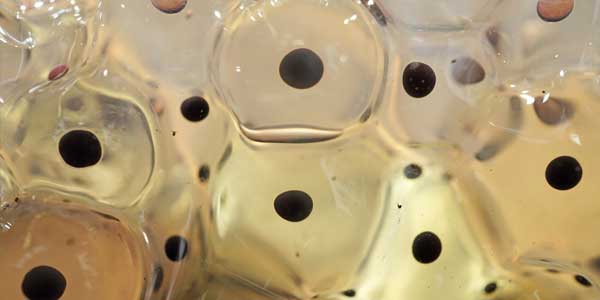
I started to look in the larger of my ponds for frog spawn at the beginning of February. Right on time, on the 4th of the month there were two big clumps of it.
There was also quite a disturbance in the water and I counted seven frogs all trying to do what frogs do at mating times.
I know that sex carries toads to extremes but I hadn‘t realised that it had quite the same effect on frogs.
They hung around for about 24 hours, leaving spawn that looked a bit like jellified caviar, and one exhausted looking frog – presumably the female.
Three weeks later, almost to the day, a plastic plant pot had blown into the pond.
It had landed sideways so that part of it was submerged over some of the spawn and as I stood there cursing the fact that I couldn’t fish it out,
I suddenly realised that it was half full of tiny wriggling tadpoles!
They had hatched on time – about three weeks – in spite of snow the night before and two or three quite hard frosts during the days preceding it. Good old nature.
If all the spawn hatches like that, I won’t have any slugs to worry about in my garden this year.

Blackbirds kept me amused for several weeks.

During January five males and a female were regular visitors.
The males grew increasingly cross with each other as time went on, ending up with vicious fights on the lawn as they sorted out their territories.
The female gave all the males the cold shoulder for some time but when a second turned up to join her, they both ran off in alarm every time a male turned his attention to her.
Now there is one male and one female and they both feed at different times.
For a while the female often stood around for minutes on end looking thoughtful. I can guess why because she then rushed about gathering bits of moss and this and that, on a home making quest. One of the males has quite a few brown feathers on the left wing and as he seems to be the most regular visitor, I suspect that he is the victorious one of the original five. I have called him Mr Pavorotti and for those who remember that far back, I would love him to be a successor to Mr Bocellii.

The dawn chorus is getting earlier, keeping up with the first light breaking.

It’s now starting soon after 5am. It won’t be long before they all begin to suffer from serious sleep deprivation, what with the light and newly hatched offspring to cope with. Not unlike humans really.

Referring back to my previous reference to slugs and frogs

Have you heard that gardeners should start to be kinder to those little slimey things?
It was even on a news programme this week.
There are only one or two varieties that actually attack our garden plants, the most common of which is the common garden slug.
It is about 3cm long, brown and striped lengthways, sometimes with tiny gold, orange and yellow spots on its underside.
So what we’re supposed to do is throw them onto our compost heaps where they will happily munch on all the rotting vegetation therein.
They omitted to mention whether they would stay there or wander back at the first sight of something juicier a few yards away..

Well, I’m all for saving wildlife but I do draw the line at this one.

I just cannot imagine the average gardener going around and picking off and turning over every slug they find to make sure its black and striped and attractively spotted with orange, gold and yellow beneath, and then transporting it to your compost heap (that‘s if you have one).
Your average gardener is as keen as anyone to preserve wildlife, but as there rather a lot of slugs about, if he did this he probably wouldn’t have time to have a garden at all.
Am I wrong in feeling slightly indignant and that this suggestion is slightly batty?

Read More
On one of those very wet days we have had recently, I watched a small white shelled garden snail trailing down the streaming window, heading purposefully towards the bird feeder that is attached there.

I have read that snails enjoy bird food as much as birds do, but I don’t see them on dry days, when, I suppose they stay at ground level, busy mopping up the spills.
It raises several questions: why is it only this one that heads for the window and never the other, larger varieties, why does it only do it when it is wet and how do they know the food is there?
Does bird food smell stronger when it’s wet and how do snails smell it when they have no visible noses?

I did my usual search

I discovered that on the underside of these odd little creatures, which is the bit that was immediately obvious from my side of the window, is a tail, a foot and lower tentacles.
On its upper side there is a mouth, upper tentacles on which are the eyes, its head and its shell. These upper tentacles, I then discovered, are used for orientation and can detect scents – but then that raises another question. Presumably the bird food smells stronger when it’s wet but it must be a pretty strong smell to attract this little thing from its cosy home amongst the leaves and roots of my cherished plants to make it want to climb half way up several feet of rough brick wall, find the window, then slither half way across it to the feeder.
It’s just one more of those wonders of nature that never fail to absorb me for – well, not quite hours in this case, but quite a long time.

One thing leads to another.

Do birds have a sense of smell? From the same source of information, I found that they do have little nostrily things on their beaks, called nares, but the scientists say that these aren’t very helpful and they are still trying to find the answer.

It’s a depressing fact that the UK is ranked 189 out of 240 countries in its biodiversity.

This is due mainly to the industrial and agricultural revolution during the 19th century. (Thanks Google for telling me that – happy new year to you too!)
The thing is, we didn’t know what damage it was going to do in the future.
Who would have guessed when the first iron was triumphantly produced, that the chimneys of those very fires used in its manufacture would have such far reaching effects centuries later?
And where would we be today if someone hadn’t had the bright idea of producing railway lines and engines from this wonderful material to rush it to all corners of the country?
From all that came so much of what we depend on today, from the bridges that cross roads and rivers to almost everything in our homes, and aeroplanes that take us to far away places – there is not much that doesn’t depend on even a fragment of this metal in its making.
In the same way, more recently, who could have imagined the damage that plastic would do when it first appeared? It’s sad but true that so much of what we do today can cause unknown havoc tomorrow.
We are now back peddling furiously, re-planting trees and native hedgerows, creating more areas of salt marsh and restoring damaged peat lands.
We are doing our best to decrease our use of fossil fuels, and many of us nowadays, who have gardens, think about making it as nature friendly as possible.
And, of course, we have David Attenborough who makes us so aware of all this.
Lecture over – sorry.
I’m not sure what got me going on that, except perhaps I started this article the Friday after all those floods, which we are told, are mostly due to climate change.
I looked back on my notes for this time last year, and, guess what? I was moaning about the amount of rain we were having then!

I have had several visits from little flocks of long tailed tits.

They are such delightful little birds.
They come in little groups of about a dozen at a time, don’t stay long and disappear as quickly as they arrive.
I’ve discovered two wonderful collective nouns for these little fluffy bundles from way back, ‘bum barrels’ and ‘poke pudding’. Those are as good as a charm of goldfinches, though perhaps less complimentary.
I have both a robin and a blackbird regularly feeding from the window feeder (apart from the snail.) I’m sure the Robin is Fraser and he seems to have a mate, and the blackbird I have called Pavarotti as a nod in the direction of our much loved and long ago deceased Mr Bocelli and wife,
Some of you may remember me going on about them several years ago. Pavarotti is recognised by several distinct brown feathers on one wing and although I haven’t heard him sing yet, I’m sure he has a splendid voice.
He and Fraser seem to take it in turns to feed, one sitting on a nearby rail until the feeder is vacated, but I have witnessed a couple of occasions when Fraser has grown
impatient and tried to muscle in at the same time.
This usually ends in a bit of a one sided war. Pavarotti, being the larger, usually seems to be the victor.
Recently, there have been five blackbirds around the lawn at the same time. When there were only one or two around following Pavarotti I thought they could be his last year’s offspring but five seems a bit much.

Maybe sex is in the air. It has a funny effect sometime.
Read More