
Because of a slight mishap between the fridge, a jar of coffee and my left arm, I have only been out on Genevieve once in the last few week.
That trip didn’t last long as it was more uncomfortable than I had expected, but I got round The Wheel and it was quite satisfying.
Several meadow brown butterflies were around, all looking rather dingy after the brightness of the red admirals which were visiting my garden that same day, but they were fluttering around the damp and flattened September grasses and it was nice to see them.
There also seemed to be quite a good crop of blackberries, but many of these were small and very pippy-looking and, I am assured that even those that look promising have little flavour – a result of the wet season.
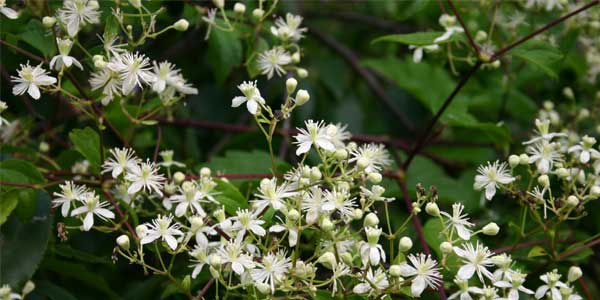
Most of the hedges round here are clothed with wild clematis.
The seeds of their green and white flowers have now ripened and each one of them now bears shaggy hairs that are borne away on the wind.
By now it looks as though someone is airing pale grey blankets on these hedges.
It is a plant that likes chalk or limestone and as the soil round here seems to vary almost yard by yard, this explains why all the hedges are not festooned.
It is known as Traveller’s Joy simply because of its beautiful shaggy hairs, even though I never think it looks particularly joyful as it approaches the end of the year, by which time most of the blankets seem to take on a very dull grey appearance.
Fleabane and Black Bryony
I noticed that there were several clumps of fleabane, looking a little less bright that usual, and beaten down low by rain. These usually bright, daisy-like flowers were so known because they were used to repel fleas. Owing to a diminishing supply of these nasty little insects, I was always pleased to find satisfyingly large big sweeps on our moor in Devon, as I did here on Lydlinch Common.
Here and there sealing wax red berries of black bryony decorated the hedges.
These are avoided by birds and mammals as they are a very powerful poison, and, if odd little snippets of information appeal to you, this is the only member of the yam family that we have in this country.
Meanwhile, in my garden, I have been noticing worms, or rather, what they do.
When I was little, my father used to draw pictures for me of a worm propped up on a walking stick, hat on its head and pipe in its smiling mouth.
I don’t think I’ve ever seen a worm with a mouth, with or without a pipe.
Looking it up in a book though, it does seem to have a very small sort of mouth piece which it uses to pull a leaf gradually underground.
I have watched this operation from the top, ie., with the leaf gradually disappearing from view.
It takes a long time but it is interesting if you have quite a lot of it to spare.
Of all autumn berries, the spindle is my favourite.
From such insignificant beginnings of small, greenish flowers, come vivid autumn fruits, their bright pink, four lobes splitting to reveal the clashing orange-coloured flesh.
It is poisonous and a violent emetic and used to be used as a purgative long ago, or else baked and powdered to be rubbed into the hair to get rid of head-lice.
It doesn’t do sheep and goats much good, but birds love them and they seem to be the main broadcasters of its seeds.
Many hundreds of years before the invention of the first spinning wheel, the spindle’s thin, strong stems were used by women to spin raw wool.
They twirled a stick of this wood between their fingers and called it a ‘spindle‘.
Spindles such as these have even been found on prehistoric sites.
Centuries later, its smooth hard, wood was found to be ideal for pegs, knitting needles, skewers and even toothpicks and these days bushes of them are often found in ancient hedgerows or woodlands.
Brian and I used to walk to Rue Lane where we knew there was one and we would rob it of a few of its lower branches to take home to put in a copper jug in the fireplace.
Now I have one, very prolific bush in my own garden.
Glancing through one of my Naturally Thinking notes of 2011
Glancing through one of my Naturally Thinking notes of 2011, I read that the average five acres of grassland contains about 1 ton of insects.
What’s more, the number of spiders in 1 acre of hay meadow contains 2.25 million of them and as each spider eats approximately two insects per week, it works out that they consume a total of around 108 million insects, give or take a few that they missed.
I don’t know where I got these fascinating facts from, which is a shame because I would like to compare them with the facts that we have for the last few years when numbers have fallen so dramatically.