NATURALLY THINKING

By Margaret Waddingham

Articles published in the Caundler Magazine

I’ve been watching the hogweeds

After drifting along with the clouds for most of August, we suddenly found ourselves trying to find some cool, shady spot for three whole days just when the schools returned, and then, just as abruptly, we were again under cloud canopy.

At least these clouds produced some welcome rain otherwise we would all have been crying ‘drought, drought’. It has been recognised as a wet summer so I wonder why it is that the water table seems so low. Surely, in days gone by gardens didn’t flag and fields didn’t crack so quickly after a wet season? I suppose it’s all due to climate change.

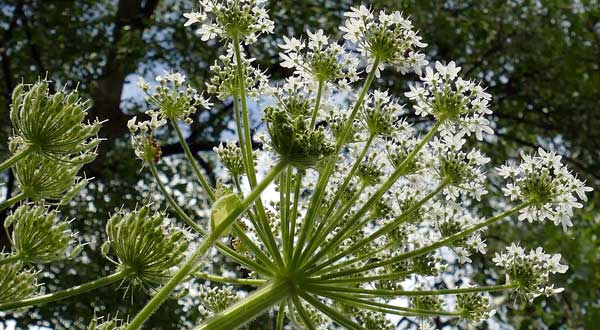
Down Rowden Mill lane, I’ve been watching the hogweeds because they remind me so much of the moor when we lived in Hatherleigh.

I had at that time become particularly interested in why different insects seemed to prefer different parts of the plant and so I searched back through my notes of the time to compare them with what I saw now. Sure enough, in August 1991, I had recorded how one hogweed plant had played host to a variety of insects and which particular bits they were interested in. On the top of the flower head there were half a dozen yellowish red soldier beetles and two little yellow striped hoverflies that hovered on or just above it. Below that were several elongated beetles with scarlet wings and a black head, later identified as click beetles, and below that was a very large web stretching from one of its leaves to a nearby gorse bush. At the very base were three small black slugs. I was intrigued by the part that the hogweed was playing in the lives of all these little insects. The soldier beetles are carnivorous so presumably they were snapping up all those harmful little bugs that might drop by and eat the flower. The hover flies feed on aphids amongst other things, so presumably they caught anything that the soldier beetles missed and, in addition, pollinated the flowers. The click beetles enjoy a good feed on rotting vegetation so they help to keep the plant tidy, whilst the spider grabs anything else that is foolish enough to fly too close. Little black slugs are omnivores and I suppose eat anything left over by the others. Their menu can include fungi, little earthworms, rotting vegetation, dead plant material and dung, in other words, they would protect the plant from quite a lot near its root. With all those sentinels protecting it, it’s small wonder that the hogweed is one of the successes of the plant world. It still doesn’t explain why each seemed to keep to one particular territory
though. Down Rowden Mill Lane, I did see a couple of soldier beetles on the top of one, together with some large flies and a few bees round several but if any had that same army looking after them, I missed them.

I have been entertained by the families that gather round the bird feeders.

As soon as the querulous adult goldfinches flock in, their offspring arrive too, usually sitting on top of the feeders looking pathetic and hoping their parents will remember that they are still not able to work out how to cling to the feeders. They never do. Fair enough, they have to learn how to fend for themselves and ignoring them is the probably a bird’s best way to do it. After a while, the youngsters, their backs well coloured in their goldfinch livery but their fronts still fledgling pale, line up under the feeders gathering up what falls down. This is the signal for other families of ground feeders to join them – chaffinches, sparrows and the occasional young robin, not yet red waist-coated. The tit families are much kinder to their youngsters. They seem to feed them until they can hang on upside down themselves.
There are still some late nesting house martins under my gutters that haven’t yet managed to coax their offspring away from their nests, though every morning I see bigger and bigger numbers of them circling round, feeding on the insects that will help sustain them on their journey to the warmer climes of Africa. The swifts, of course, being the first to arrive, were first to leave and did so long ago leaving the church tower strangely silent.

Read More

In June I went up my usual lanes with the purpose of counting insects

One fine, warm day in June, I went up my usual lanes with the purpose of counting how many insects I could see.

Up Holt Lane I spotted a tiny iridescent beetle, one bumble bee and several butterflies. Down Rowden Mill Lane I found about six bumble bees and several little brown butterflies, probably gatekeepers.
I was, of course, only counting what I could see on the nearest edge of the verges and probably if I had been able to actually walk on them I might have seen a few more. Even so, it was rather depressing. I mentioned this to a friend I met on the way back saying that I seemed to have many more in my own garden than I had seen that afternoon.
He said that perhaps we are now becoming so conscious of planting lots of flowers with insects in mind in our gardens that anything that flies has moved on mass away from verges.
A few nights later, I couldn’t sleep so I put the light on and read for a while. My curtains were not completely closed and the windows were wide open. It occurred to me that the room would soon be full of moths but there wasn’t one.
Some days later another friend drew up beside me in her car. I said ‘Oh good, your windscreen is smothered with dead flies.’ She looked at me sadly as though I had completely lost the plot and I explained that I had been searching for insects, dead or alive. She drove off shortly after that. I can’t remember whether it was because we were blocking the road or because she doubted my sanity. When I got home, my garden was noisy with the sound of bees, but they were all bumble bees of several sorts and various hover flies. Only two honey bees. Still, that was better than nothing, but oh Tim, if you still have some,please direct them to my end of the village! By mid July, numbers have increased but nothing like the numbers that should be buzzing around. I found the top flowers of hogweeds that had quite a lot of little orange beetles doing their bit and one afternoon after a morning of rain, the garden was once again filled with all sorts of things that buzzed, flew or fluttered.

However, numbers everywhere are down and it is a very sobering problem.

40% of insects are at present declining and one third of this number is dropping faster than mammals, birds and reptiles. At this rate, they will vanish completely by the end of the century.
I couldn’t bear to read any more – ostrich-like I prefer to bury my head in the sand, continue, like many of us. to plant as many nectar-rich plants as I can in my garden and hope there will be a miracle to turn the forecasted tragedy around.

I thought my big pond – the one Steve dug for me last year – had a leak.

The water level seemed to be going down at an alarming rate, and even allowing for the strength of the sun these days, I was beginning to think this must be due to something more serious than evaporation. I had to keep asking people to fill it up for me.
I still had quite a lot of tadpoles with minute back legs developing and I was putting their slow rate of development down to the effect that the tap water was having on them as it was so constantly being
added to their watery home.
One day at the beginning of July, the level seemed to drop even faster and having asked for it to be completely filled to the brim one weekend, by Thursday I found to my horror that there was no more than a couple of inches left in the deepest part and the pump for my bubbling rock was making a most alarming noise. By the next day when Steve came hurrying round to see what was happing, there was just a very small puddle left.

Steve looked at it and almost immediately said, ’I think I know what the problem is.’

I had allowed some self-seeded mimulus to have their wicked way just beside my rock. They looked very pretty, full of flower and getting bigger by the day. The trouble was that, unseen by us mere mortals,
the wretched things had spread their roots further and further beneath my rock, taking soil, stones, and even chunks of clay with them until the water was re-directed to the bed behind the pond instead of back into it. Steve yanked the whole lot up, refilled it and it’s been full ever since.
It will be interesting to see whether it drops dramatically when it stops raining, but I doubt whether it will. What’s more, six of my minute little tadpoles have survived their trauma. Resilient little things, aren’t they? I do hope they finally become frogs.
I have learnt my lesson – no more self-seeded anything will ever be allowed to stay anywhere near my bubbling rock.

Read More

The Miracles of Nature

Who says that insects have no brains?

Well, I did, except that I always thought that spiders had a bit more than most, working out how to make those intricate cobwebs and all that.
One day at the end of March I saw something in my kitchen that confirmed this.
I was about to go to the fridge to get one or two things out for breakfast when I noticed that the corpse of a woodlice was swinging gently from the bottom of the freezer door, which is beneath the fridge.
As it was swinging in rather an odd way, I looked at it harder and saw that a minute spider, whose body was about the size of an elongated pin and legs so tiny that I only knew they were there because I could just see that they were moving around the woodlouse.
Then it climbed up its little silken ladder and vanished for a moment somewhere in the cavity beneath the door’s overhang, at which point the woodlouse began to swing gently again.
I was so intrigued that I abandoned breakfast and watched this little drama instead.
The spider was very methodical. He came down an almost invisible thread of silk, spun a little more of it around the body, and then he disappeared out of sight – again and again and again.
By this time it was obvious what was happening and I wished, not for the first time, that I could draw cartoons because I could just imagine it sitting in its lair out of sight and heaving on its web like someone playing a salmon. Eventually, I had breakfast and by the time I had finished the woodlouse was out of sight.
The whole operation, from the time I had first spotted it, had taken the little spider about an hour to haul its meal from floor to its lair, a distance of about two and a half inches. I wish I could put this into some sort of scale.
About a week later, a dried corpse appeared – I suppose it was the spider’s compost – on the floor beneath the freezer door.
Woodlice seem so very unfleshy and unappetising that I am really curious to know which part of it that spiders enjoy.

The ash is very late coming into leaf this year.

Curious to know why it is that some years the oak is first and at others it is the ash, I googled it and this is what I found. Usually the oak comes into leaf from late March to early May and is temperature sensitive. This, by the way, now comes into leaf about 7-10 days earlier than it did 30-40 years ago. However, I seem to remember a sudden bit of a heat wave in March as well as very welcome sunshine. It didn’t last long and when April arrived, we had record sunshine but accompanied by frosts. So now this May, the ash, which is dependent on the sun, is hanging about a bit until it can be sure that both sun and warmth are here to stay, whilst the oaks are in leaf. I can’t help feeling the trees are as confused as we are.
The oak seems to be adapting to climate change but the wild life which depends on it, such as the oak caterpillar moth that the Great Tits feed on, hasn’t quite caught up. Hopefully it will sort itself out soon and food will again be around for those that rely on it to feed themselves and their young.

What a year for blossoms this has been.

The flowers of the apples seem to have been so tightly packed together that it’s a wonder that the bees have been able to squeeze in. The heavy frosts that we have had don’t seem to have affected it, so stand back and prepare for a bumper crop. In fact, there should be a bumper crop of everything from holly to sloes.
Like many in the village, I had a lot of visits from the little bee flies this year. Looking like tiny humming birds pausing to sip at the spring flowers with their long proboscis, they are rather delightful little creatures looking, as their name suggests, a bit like a bee with a round, fluffy back end whilst the front end is more like a fly. There are several different sorts – I rather think ours are the spotted bee fly, so named because of the spots on their wings. They are, to me, as special as the humming bird hawk moths which come out much later in the year, except that their pupaes’ favourite meals are the baby solitary bees who share the same underground homes in my front lawn. Those too are amongst my favourites of the insect world that I have around me, emerging like a blue haze on warm days at this time of the year. Still, I suppose you can’t have everything in this world.

It’s amazing what a difference two or three weeks make at this time of the year.

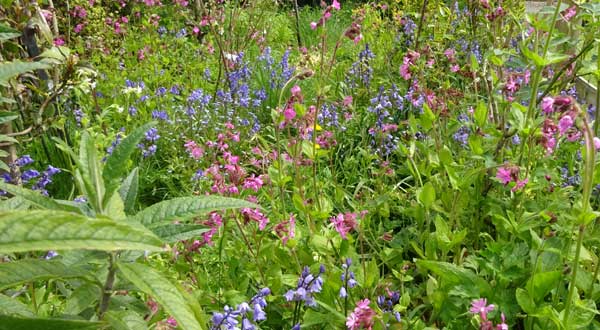
Having not gone out on Genevieve for that length of time, I dodged the showers and went down Rowden Mill Lane and Holt Lane the other day, to find that most of the cowslips had all but disappeared beneath the lengthening grasses. It’s pleasing to see that these flowers are gradually increasing in both of these lanes. The Red Campion too, which had been in bud on the previous occasion that I had been there, were now fully out, sturdy and rich, and misty Bluebells were growing at the foot of the hedges. The verges everywhere were frothy with Cow Parsley. This is a member of the Carrot family but if you crush the leaves between your fingers, the scent is faintly aniseedy. I do so love the red, white and blue and that special green of young grasses at this special time of the year.

Read More

All that is needed to nature watch is to go quietly and pay attention to the surroundings

With two days left in February before it merges into March, I went down Rowden Mill Lane to see what was going on.

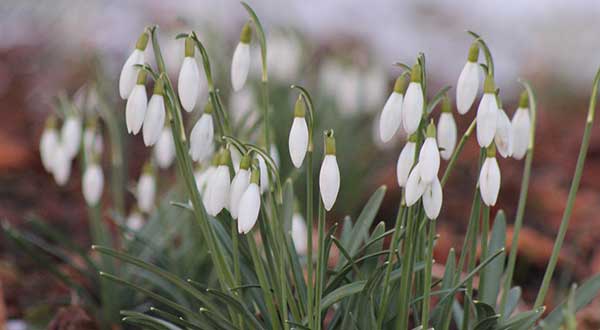
Lots of celandines, patches of primroses, a bit of cow parsley, a group of snowdrops and a tentative white deadnettle were flowering, whilst spikes of other things had pushed through, things like the leaves of lords and ladies. There were rosettes of thistle, silver with the morning dew even though it was nearly mid-day, and leaf buds swelling on the hedges. There were quite a few birds around: robins, a dunnock, wrens in full scolding mode as I passed, and as I neared the big field near the bottom of the lane, a harsh chattering came from a large flock that was just taking off to pastures new – fieldfares I think. A buzzard was very vocal near the river. I hadn’t heard him last year which had me a bit worried because they had been there every year since I had been going there in my walking days, so I was delighted to hear this one.
Tracks of animals going from one side of the lane to the other are easier to identify at this time of the year, claw marks of a badger or small hoof marks of deer clearly imprinted on them. Once, a few years ago, I found a badger latrine near a deep hole. Not only did it contain the obvious but a lot of old bedding in the form of dead bracken and other vegetation. I have never found one since.
A lot of bleached snail shells, large and small and different sizes, were lying in the mud of the verges, washed out of the grasses in the winter rains. It was a good indication of how many of them had been going about their daily activities in better days.

I am always interested in the hedges around here.

Every now and then there is a trunk that stands out from the rest, thicker and older. It is an indication of when the hedge was properly laid and some of them are really beautiful growing like sturdy, moss covered arms doing their best, even in old age, to prop up their younger companions.

This issue is all about nature watching.

I suppose I’ve done a lot of that in my time, and, like so many of us, I haven’t been conscious that was what I was doing.
Of course, it’s better if nature comes to you and happening to be in the right place at the right time helps enormously. I’m very grateful to the badger, leveret, grass snake (in the act of swallowing a frog until I startled it into letting it go), foxes, voles, field mice, slow worms and squirrels that have strayed into my garden, to say nothing of all the insects, birds, which once included a wryneck, an owl who came and sat near me one night as it was getting dark, and quite a few bats.

We are so lucky to live in such a rural and relatively unspoilt place.

When I lived in Devon, I couldn’t have been luckier to happen to pass an alder overhanging the River Torridge just when a mother kingfisher was feeding its little fledgling sitting on a branch below us. Often when I was just sitting on the bank or standing in the middle of the river fishing, there would be a sharp ’keek’ and a flash of brightest blue as one jetted past. Although I really wasn’t very good at fly fishing and hardly ever caught anything, I loved it because it gave me the chance of standing in the middle of the river without looking too daft. I often saw the v-shaped wake of an otter disappearing round a bend or heard the sharp ‘keek’ and a flash of vivid blue as a kingfisher jetted past. And what could have been luckier than the day when Brian and I were passing a salmon ladder as the salmon were leaping it to reach their higher spawning grounds? Or when we once saw female salmon making their redds? These are the nests which they create by furiously fanning their tails to create small depressions in the gravel in which to lay their eggs
Brian often used to go fishing in the early mornings and he had two interesting meetings with otters. One nearly knocked him off his feet as it tried to swim between his legs and on another occasion, having caught two beautiful wild brown trout and put them lovingly in cool, long grasses on the bank, he found, as he retrieved them a little later, an otter chomping its way through them. I would have dismissed it as a fisherman’s tale except that he brought the evidence home to show me!

Sometimes I suddenly came across something quite different.

One day during a very hard winter, the river was freezing over in places and I was stopped in my tracks when I heard a musical clanging sound. It was floating ‘icebergs’ that had been washed into a small bay in the river and were all clanging together. That same day a mass of them collected beneath the bridge further downstream, completely preventing the flow of the water. By morning temperatures had risen enough for them all to have floated away.
Perhaps the most amazing stroke of luck was that we moved to our Devon home near the edge of Dartmoor and found that the town had its own very precious piece of culm grassland with its wealth of flora and fauna which gave me my most precious insight into what went on there and should be going on in other places if only we hadn’t inadvertently messed things up so much.
All that is needed to nature watch is to go quietly and pay attention to the surroundings. We are so lucky to live in a rural place where nature is all around us. Long may it last.

Read More