NATURALLY THINKING

By Margaret Waddingham

Articles published in the Caundler Magazine

In the middle of a dull winter’s day, it’s nice to think of summer

Good heavens, Christmas is almost upon us again.

And since the last few months have gone past in a bit of a haze and I haven’t been able to get out very much, it seems a good time to think back to a heady day in summer.
Forgive me if you were expecting something a bit holly and ivy-ish but sometimes in the middle of a dull winter’s day, it’s nice to think of summer, so here goes.

We amble a great deal, Genevieve and I (Genevieve being my mobility scooter for those who don’t know me

Especially during the warmer months, and it can easily take us an hour to go to the bottom of Rowden Mill Lane and back. One afternoon during the last week in July I was doing just that, pausing every few inches to look more closely at the verges and hedges. Most of the more showy flowers were over by then and many of the grasses gone to seed, but the Great Willowherb, which has leaves that are more grey than the Rosebay Willowherb, lined the hedge bottoms near what would have been a damp place if we had had more rain.
In Devon this flower is called ‘Codlins and Cream’, perhaps because the colour of the flower resembles a cooked codlin apple mixed with cream. There was some Meadowsweet about still, an almond scented flower that used to be picked in great bunches and strewn before a bride. It was also used medicinally because it has the same properties as aspirin.
The hedges, the darkening green of mid to late summer, were festooned with white Bindweed, whilst spattered amongst the grasses of the verges were little white and pink Field Bindweed, looking like abandoned tutus. These are all of the Convolvulus family. Many of their much better behaved cousins are quite pricey in garden centres.
Also festooned on the hedges was wild Clematis whose creamy flowers turn to little grey mopheads, known as Old Man’s Beard, in the autumn, and garlands of Bryony whose green berries turn to gleaming sealing wax red.

Now and then I stopped to listen and look.

I keep hoping to see hares but they are all out of my range of vision whilst sitting astride Genevieve. I like to listen to whatever birds there are around. Several little flocks, probably of meadow pipits, danced ahead of me from one side of the road to the other, but at this time of the year not much else was singing apart from yellow hammers. There were two of them that day, one nearby and one further away, both seemingly to have forgotten the last bit of their song so that it came out as ‘little bit of bread and no’ without the ‘cheese’ bit at the end. Meadow brown butterflies, gatekeepers and small whites took off continually, sometimes confusing Genevieve for something that she wasn’t. No other butterflies at that time of the day though.
I like to listen to the wind when everything else is silent.
Much as I admire Rupert Brooke’s poetry, I have never actually heard the breeze sobbing in the little trees which was how he described it in his lovely poem about Granchester. Sighing, rushing, moaning, sometimes whining, but I can’t honestly say I have ever heard it sobbing. That probably says more about me than it does about Rupert Brooke.

Anyway, that particular day it was sighing pleasantly, a particularly satisfying sound on a warm afternoon.

About half way along the lane there were more low growing flowers: dainty little Vetches scrambling through the grasses, a stray Buttercup or two, white Clover and several clumps of white Deadnettle. Thistles abounded, mainly two sorts – big, handsome fellows which I think are the Spear Thistle and a much more slender one with several heads, which may, or may not be the Slender Leaf Thistle.
I am open to correction because, as you might have guessed, thistles are not my strong point.
Here and there were the occasional fading stems of Hemp nettle and, at the bottom of the hedge were stiff little Lords and Ladies with their closely packed berries just on the turn to orange.
Some of the bottom berries had been nibbled – insects or mice I wondered?
In the gateways there were big patches of white daisy-like flowers of Scentless Mayweed. I wonder why they seem to prefer gateways? Perhaps because there is less competition from other things.
On one side of the road there is a narrow patch of Pineapple Mayweed, nothing like the other. It is insignificant and low growing and prefers to be almost on the road itself. It smells strongly of pineapples.
At the back of the verge Burrs and Teasel stand proud, and almost hidden from view in a tangle of grasses were some dainty yellow Meadow Vetchling. Down by the bridge the lovely blue Chicory still flowered.
All this but not a sound of an insect – no grasshoppers madly stridulating or bees humming.

At the bottom of the lane I can go no further than the house which stands alone and, still being empty, I turn here and pause.
At present I enjoy the liberty of sitting on this drive and looking round. On the far side, there were big stands of Purple Loosestrife by the river and a small pear tree heavily laden with fruit.
It was a warm, sunny spot and I watched two robins going backwards and forwards between the grass and their nest hidden in the nearby hedge.

There is a small, neat rabbit hole in the bank beneath this hedge.

A baby rabbit sat on each of the warm little hummocks on each side of the burrow, dozing.
The ears of one of these were constantly twitching backwards and forwards and now and then it briefly opened its eyes. It finally hopped away through the hedge and not long after, the other followed it. All young animals have a charm but there is something about a baby rabbit that is especially appealing, though I’m not sure farmers share my opinion.
It was a satisfactory end to that day’s amblings. By now, of course, the hedges have lost their leaves, though still clad with grubby looking Old Man’s Beard and only seed heads remain to show the glories gone by. Even so, there will still be things for the careful watcher to see.

While trying to come to terms with the diagnosis of Parkinsons for her husband last year, my daughter walked in a wood where brightly coloured leaves were falling, ripe nuts were everywhere and fungus of all sorts was growing on fallen trees, and she thought, ‘Autumn isn’t the end of things, it’s the beginning of the birth of something new’.

May you all have a very happy Christmas in spite of everything and let’s hope that we may all look forward to the birth of something new.
Read More

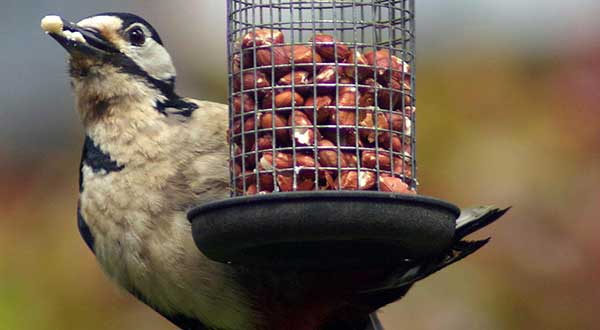
Birds can be hugely entertaining.

My peanut holder, hanging on one of the posts of the arbour, is visited regularly by the greater spotted woodpecker, parents and their two off-spring.

Unfortunately, it is also the favoured drop-in centre for a very large family (maybe even two or three families) of noisy starlings. Because there are so many of these, they sometimes try to get on to the holder at the same time during which a fight ensues resulting that the top be- comes loose and the main part, including peanuts, falls onto the ground.

If a woodpecker gets to the feeder when the starlings are around, they line up on top of the arbour and scream abuse at it

But it doesn’t take much notice, just gives them a dirty look now and then.
One day the woodpecker left for a short while but when it came back the holder was on the ground. It tried feeding there for a moment or two, but, preferring to take its meals in the proper way, i.e. well away from the ground, it climbed the post, got to its usual spot, pecked at nothing and looked around in surprise. From then on I could almost see think bubbles come out of its head. It pecked at nothing, looked round, pecked at the top which was still hanging from its hook, looked all round again. ’Where’s it gone? I know it was here earlier.
Am I in the wrong place? Is it here? (Looking to the right) Is it there? (Looking to the left) that’s surely not it down there? I’ll go and sit in a tree and think about it.’ So it had a little ponder in the neighbouring ash, then gave up and flew off somewhere else to find a meal in a decent place.

I’m so pleased with my Covid pond

Like Billy in the last issue, my pond has been dug, developed and inhabited during the lock down and watching what comes and goes to my bubbling rock that keeps the water on the move is fascinating. Sparrows, chaffinches, gold- finches especially love to balance on its rounded, slippery surface and drink from it, and, like children playing in a hose on a hot day, they line up to rush through the gently bubbling jet to have a quick shower. I’m so pleased with my Covid pond which has already attracted not only frogs (with thanks to Ray), damselflies and no end of little squirmy things, but at least one baby newt.

At the end of June, Genevieve and I were ambling along Holt Lane when I spotted two single stems of corn cockle.

At first I thought I had been mistaken but, although it was at the back of the verge and at first glance thought it was a bit of mallow, the more I looked at it, the more distant memories of childhood said, ‘corn cockle.’ I checked when I got home and it certainly fitted the description.
It was a deep pinky purple, shading to white in the centre, and I wished I could have got nearer to see more detail of both flower and leaf. However, it was quite unlike any other flower around and I’m 99% certain what was it.
It’s an interesting flower, originating right back to the Iron Age so it is said, but now only occasionally found on the margins of hay meadows, roadsides, railway lines and open ground. It began to decrease rapidly in 1952 after being seen as a pest by farmers for hundreds of years because it is toxic to cattle. It finally died out as result of seed cleaning and herbi- cides. It is now almost extinct and is on the Vascular Red Plant Waiting List, which is a list of endangered, threatened and near threatened plants. (Found that on Google – I’m really not that clever).
So how, if it is indeed a corn cockle, did one little plant end up in Holt Lane?
No idea.
Perhaps the seed remains in the soil for years or maybe it has always been there, quietly lurking away among the grasses. Anyway, thank goodness that part of the verge es- caped the ravages of the mower a few weeks ago. When I went to look for it again in mid-July it had disappeared. It had either gone to seed or I was just having a rather nice dream.

I am similarly delighted with another beautiful flower by the little bridge near the bottom of Rowden Mill Lane.

There are two of them growing adjacent to each other, and now so tall that they are at the toppling over stage.
This is chicory.
It has quite large, bright blue daisy-like flowers, and belongs to the dandelion family. My book says it is quite common in Southern England but it’s quite hard to miss and I haven’t often seen it. It’s in full bloom now if you want to have a look, though it seems to pause every now and then before it bursts out again. During the war its roots were often used as a coffee substitute.
I wouldn’t try it if I were you unless you want to be put off coffee.

Whilst on the subject of lanes, I’m fascinated by the way we are told we can date our hedges.

Rule of thumb says multiply the number of species in a 30 yard stretch by 100 plus 30. Who am I to be so sceptical about this? It does make some of the hedges round here an amazing age but what about those mixed hedges that have been planted fairly recently?
However, a mixed hedge which contains field maple, hawthorn, spindle, bramble, holly, guilder rose and beech with bluebells and primroses growing in amongst it all, could well be ancient.
Leave it to you to work it out.

Read More

The recent months have given nature a breathing space

A chance to see what the world would be like without the heavy hand of man putting his foot in it, if you’ll pardon my mixed metaphors.

Many birds, but especially those ground nesting ones, are doing better than usual.

We are much more conscious of bird song now that they don’t have to compete with the roar of traffic and planes. All over the country there is a growing movement of people who have become involved in gardening which benefits nature enormously.
Road kills have been dramatically reduced (very good news for toads I am told) and delays in verge cutting have meant that wild flowers are having an exceptional time, bringing an explosion of colour to the eye and pollen to the pollinators. Butterflies are doing rather well too, as are insects generally, perhaps because there aren’t so many windscreens upon which they can kill themselves. And of course, shrinking pollution belts everywhere have greatly improved the air quality giving us a glimpse of what things would be like with greatly reduced fossil fuels.
So when all this finally ends, could we possibly maintain just a small level of sustainability for this improvement? Perhaps more people will work from home lessening the demand for more and more roads and public transport. Maybe we will think twice before jumping into our cars to reach beauty spots and beaches but keep up with a newly found interest in cycling and walking. Maybe the airliners will have to prune back a little. Maybe.
Here in England we luxuriated in the warm and dry weather, of April, although farmers and growers were once again the losers. After the flooded fields during the wettest winter on record delaying crop planting, they then watched in disbelief as those same fields became cracked and arid.
We, on the other hand, enjoyed it, breathing in warm, clean air and revelling in the wealth of wild flowers. Everywhere things seemed to be in bloom all around us. My favourite outing for Genevieve and me (in other words my daily exercise) is up Holt Lane as far as the road will take me before it gives way to footpaths, then back again and down Rowden Mill Lane. The succession of wild flowers in Holt Lane was wonderful. One day towards mid-April I counted 21 varieties.
I came across Harry one day, tidying up the plastic sleeves around the sapling oaks that the Council filled in between the older ones, many of which had died. I asked if he knew who had planted the original ones, and he told me that it was Oliver Simon some 45 years ago. Can there be any better legacy to give a village than a whole avenue of trees?
The nice thing about Genevieve is that I am able to ‘amble‘, stopping frequently to catch sight of a particular bird or to examine the latest flower or insect. It is a lark filled place, filling the air with song. Holt Lane especially seemed to be alive with butterflies this year – yellow brimstones, peacocks, tortoiseshells, orange tips, holly blues, cabbage whites – sometimes they seem to get caught up in a stream of one way traffic and accompany me for several yards. And of course the views there are spectacular, with the distant hills of Blackmoor Vale rising up mistily and here and there glimpses of outlying homes and farms. I was delighted to find some milkmaids out in Rowden Mill Lane. – only a few but I’ve not seen them there before.
There are two places in the hedgerow where I have often heard a bird chattering away with a rich, varied and musical song. I have a feeling that it may be a siskin but I’m really not very clever on birdsong. I stop as near to it as I can and although I can place where it is coming from, I can never see it. People keep telling me that they have watched hares in the fields down here but they are out of range for Genevieve and me.
The house martins are back in their summer residences beneath the gutters at the front and back of my house. They make an awful mess once the babies come along, but I do love their friendly chatter near my bedroom window. I have only seen the occasional swallow and all who I meet say there are not nearly as many around as there used to be.
I haven’t heard a cuckoo either, but my Hazlebury daughter says that there has been one cuckooing away in the fields behind them every morning for days. She has also heard one in Piddle Woods, and a friend who walks on Lydlinch Common in the early mornings recently has heard one joining in with at least six nightingales.
It seems that whatever happens to us lot – humans, I mean – nature seems to be thriving on it. At least we have that to be thankful for.

Read More

Tell me, is Stourton Caundle the centre for woodlice?

Is No.1 Goldsneys the centre for them in the village?

As I expelled the latest half dozen from the kitchen one morning, I decided it was about time I found out more about the little wretches and, for those who are similarly afflicted, here is what I learned.

In the garden they are part of the army that helps to break down rotten wood, fallen leaves and anything else decaying. In the house they get going on damp timbers and mould. So what are they finding in my house? As far as I know I have no damp timbers – and mould? Surely I would have seen signs of it by now if I had that. Apparently they also feed on the general detritus that we don’t know we‘ve even got. Ok, but surely I don’t need an army of them to clear up what I can’t help leaving behind?
They are crustaceans, not insects, and can live for up to two years. I can’t help wondering what person who hadn’t got anything better to do found out this fascinating fact, but I for one have no intention of giving any of my residents a birthday party of any sort and certainly not to celebrate its second one.
Why are they now in the bedrooms as well as downstairs – I’ve never seen any climbing the stairs Apparently a Pest Control company could be called in to finish off a really bad infestation, but if things get that bad, I’ll move out and leave them to it.
The other day I was talking to a friend about the fires in Australia and she was telling me the way the aborigines used to start them deliberately in a controlled way. In those days there was seldom the catastrophe that we have seen recently.

It took me back to my time in Devon.

Do hope that you will forgive my occasional lapses into those days but such a lot of what happened during the twenty years there shaped a lot of my life.
We were seven miles from Dartmoor and Hatherleigh had its own moors, the Upper and Lower Moor as it is known. In entirety it spread to around forty acres, but the Lower Moor was just three.
Not much, you’re probably thinking, but that was a very special and precious three acres for it was culm grassland, something that is as valuable and unusual as the rain forests in Peru. It is land that has never been cultivated and the range of flora and fauna there was, and I believe still is, marvellous.

In my time there I found 136 varieties of flowers through one year

Five of those being rare or unusual, and hence a vast amount of other life.
I found a dormouse still in its nest, watched kingfishers on a tree by the pond, watched grass snakes swimming both in the pond and in one of the boundary streams, followed a whole family of bank voles through the grasses for the full width of the area one hot afternoon, found a pair of dippers nesting beneath the little bridge and listened to stonechats.
And all around, curlews flew each year and once we saw a flock of 22 golden plovers arrive.

The trouble, I quickly noticed, was that bracken and tussock grass were beginning to take over

The farmers no longer had the facilities to swale it as they used to, hence in the first three years of my ‘discovering’ this place (lots of people knew of it so I hardly discovered it), three of the precious rare flowers were being swallowed up by the stuff.
Being considerably younger then and with a distinctly interfering nature, I took it upon myself to try and do something about it.
I wrote to the Devon Wildlife, Defra, and the Parish Council, I wrote about it in the local paper. I even gave talks to local Women’s Institutes about the flowers I found there and led a walk, attended by some forty people across it to show them why it was so valuable and why it should be treasured. And of course I approached the Moor Management Committee.
This was comprised of local farmers and various other locals whose lineage to Hatherliegh went back into the mists of time and who, I am sure were thoroughly fed up with this new kid on the block making such a nuisance of herself. They were very polite though some must have raised an eyebrow when I suggested that since there was no longer the time or manpower to do it as in the old days, would they mind if I, who knew nothing about swaling, took it upon myself to organise a party to do it for them. They agreed – reluctantly – and, through notices in the parish magazine, I rallied all the troops I could muster to join me and Brian one fine April Saturday morning. I think there were about 25 volunteers, armed with things like broom handles with pieces of carpet or rubber attached to them, which, in theory were to control the flames, and we began our first and last efforts in swaling.
The idea was to do one third of it, as it had been done in days of yore, but a wind sprang up from nowhere and before we knew it, it looked very much as though the third would spread to the whole. A passing farmer came to our aid. He told us what to do and almost single-handedly saved the day.
After that, in desperation, I recruited the local pack of brownies and their leader and they had an evening leaping on all the emerging bracken crooks they could see. They had a wonderful time, but they missed a lot and it didn’t really help that much. Alas, the rare flowers had disappeared by the time we moved here, swallowed up by bracken and tussocks, and although it was still a wonderful place, many of the butterflies and a few of the insects had disappeared with them.
Some of my happiest memories were on those three acres and when I can‘t sleep I still ‘walk‘ round it.
I just loved it.

Read More

Feeding birds on a feeding station

I recently read a controversial article in a newspaper telling me that feeding birds on a feeding station of any sort is not to be recommended.

According to the writer, this may be a contributory cause of declining bird numbers because birds do not, in their natural state, all gather around in close proximity to feed, thus passing round infections and diseases. I suppose he has a point.
Certainly, we are all being told to make sure we keep the feeders clean, an instruction I incidentally, find difficult and in some cases impossible to follow. A lot of feeders are not designed for deep cleansing – it’s easier to buy a new one but this doesn’t help with the overall cost of feeding them. I’m sure that there are many arguments against his theory, not the least of which is the way the general public has become much more aware of the needs of our wild life and the fact that many of us now can recognize some of our garden visitors.

I have a lot of sparrows in my garden.

I’m never quite sure whether they are tree or house sparrows so I had to look them up to find out and I now know that the house sparrow has a grey top like the grey roof of a house, and the tree sparrow sports a brown top like a tree (obviously without its leaves). I appear to have both sorts, but they are good neighbours to each other and don’t seem to argue. I was all for getting rid of the hedge which runs along the back garden but in the nick of time, common sense prevailed. I’m so glad because it is the sparrows favourite sheltering spot. They all dive in there at any sign of danger, and if it starts to rain it is their shelter.
Every now and then their little heads poke out, presumably to see if it has stopped.

Only a few weeks ago it seems that I was still counting the stems of dead flowers that were almost as recognisable as when they had been in bloom.

Along the verges of The Wheel and Rowden Mill Lane there was Hedge Woundwort with its whorls of brittle brown flowers up the stalk and the occasional stems of oval-headed Teasel which, in days gone by, would have been used for
carding wool. There were slender pale brown stalks of Nipplewort and Willowherb, the latter tall and wiry with shreds of grey seed fluff still clinging like fine soft grey hair that needs a good wash. There was Cow Parsley too and some Hogweed, all distinctive with their rays of flat-topped flowerheads and ribbed, hollow stems. And there was Burr with its hooked teeth which is what enables it to cling to your clothes therefore earning its alternative name of Cleavers, Angelica with its more densely packed head than Cow Parsley and a slightly pinkish bud, and even some Hemlock Water Dropwort, a bit of which I have seen growing by one of the streams that didn’t dry up in the summer.
This plant is reckoned to be the most poisonous indigenous plant of Britain.
As the seasons move on, some of these remnants of summer are almost gone but still some white Deadnettle remains bravely trying to bloom amongst the flattened grasses.

One day, I went out in a rather unexpected rising wind.

At least it was unexpected to me – I thought it was quite a gentle breeze until I got half way down Rowden Mill Lane. As it stiffened, I realized that something was missing. I only saw one pair of rooks and they didn’t look too happy battling against the full force of what was rapidly becoming a gale.
What happens to birds in that sort of weather? Are they all huddled together on the largest tree trunks they can find, their claws clenched grimly around anything clenchable, or do they stay hunkered lower down in the small, more sheltered trees in the woods? Or do they deviate altogether from their normal habits and take refuge in the nearest hedge?
I wish someone would write a book with this information. There are books in plenty that are wonderful for telling me how to recognize birds from their song or their flight or their nesting habits or what they feed on.
But if there is one that is full of small, intimate details like what they do in a gale, then I’ve missed it.

Read More