
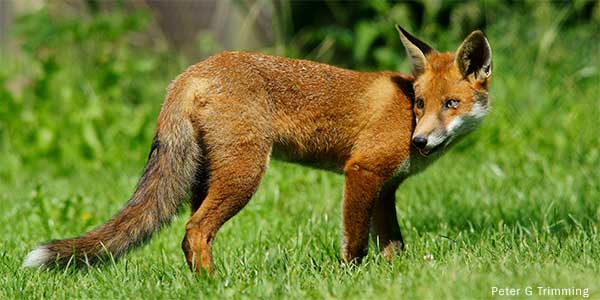
Lovely few moments
I’m sure there are some people who are not pleased to see foxes, probably with good reason, but I am not one of them.
Travelling slowly down Rowden Mill Lane one warm day recently, I stopped to watch something small and russet stalking things beyond an open gate.
He was a little past the cub stage, so had lost that cuddly look that all young animals have, but all the same he was very attractive from where I was watching.
He was on the boundary between two fields, crouching, placing his paws carefully one at a time as no doubt he had been taught by parent and instinct.
Small clouds scudded over the sun making little shadows.
He pounced on them, crouched and pounced again. Then, he seemed suddenly to get tired, so he sat down. Unfortunately, something made him turn round, he spotted me and was gone in a second.
Lovely few moments.
Thrush in the garden
I was so thrilled when I saw a thrush in the garden after an absence of several years.
Even better though was that he or his mate had been using the stones beneath the front garden seat as an anvil judging by the countless snail shells smashed there. Probably a nest nearby but I didn‘t spot that.
My friend from mid-village has been lucky though.
She had a family of three young thrushes in her garden, which she calls ‘The Three Thrushkateers’!
Families in the garden.
All during the month of June there were families of robins, blackbirds, goldfinches, starlings, dunnocks, blue and great tits and sparrows in the garden.
It’s been very entertaining watching how the parent birds taught their offspring how to fend for themselves in much the same way that we wean our own offspring from bottle to feeding themselves.
For the first few days the parent brought them to the nearest food supply and stuffed each open, squeaking beak with food. Gradually the parent spent longer on feeding him/herself until the youngsters cottoned on and decided the only way to get anything was to join in.
From then on, they seemed to be on their own, and that was where the similarity with human babies ended.
Starlings fought and squabbled noisily round the feeders and blackbirds and robins became really aggressive towards their poor parents, especially the robins who turned into the most ungrateful of offspring.
Elegant manners.
Other birds, on the other hand, such as tits, sparrows and dunnocks have the most elegant manners.
One day I found a delightful little clutch of three sparrows on the ramp, sitting in a fluffy triangle just outside the garden door.
On other days I have found baby blue or great tits sitting in close formation on the handrail of the ramp or on a branch of the apple tree.
The blackbirds seem to fledge in a random sort of way. Does this mean that they fledge one at a time whilst other varieties do it all together, I wonder? I noticed that one of the baby blackbirds seemed much slower than the others. In fact, he got slower and slower and I was quite worried about him. Then I found him (I assume it was the same one) dead under the apple tree. I’d like to know what caused his death; all the others seem fine.
Avian flu – quite safe to carry on with our feeding
Which reminds me; after being told that I shouldn’t keep feeding the birds because that’s the way avian flu is spread, I checked with the RSPB.
It seems it’s the sea and estuary birds that gather in great groups to feed and nest that are the ones that are the real culprits.
Our garden birds do not gather in such numbers, they are constantly on the move and like to nest in private.
Providing the feeders are cleaned regularly then it’s quite safe to carry on with our feeding routines (thank you Janie for cleaning mine!).
Rewidling my small garden!
It does rather irritate me that people keep telling me to rewild a bit of my small garden. Where, for goodness sake?
Anyway, the flowers I grow are always chosen with the greatest care to be attractive to anything that pollinates.
Having been searching the lanes round here lately to spot insects, I have come to the conclusion that I have many more in my garden than there are in Rowden Mill Lane, Holt Lane and The Wheel put together. That includes umpteen hoverflies, different sorts of beetles and large hatches of at least six sorts of butterflies, as well as dragonflies, damselflies and ladybirds.
There does however seem to be a general lack of bees of any sort anywhere; even bumble bees seem to be in short supply, I was delighted one day to see three bees, and some wasps around the pond.
Yes, even wasps have their uses as pollinators. I can’t help wondering whether the weather last summer and winter had something to do with our ever worsening counts of anything that flies or buzzes. I can only conclude that they were severely hit by last year’s drought, when some much vegetation necessary for their well being shrivelled and died, followed by the severe frosts of this winter.
A place that sang joyously to the glory of God and nature
All this talk of rewilding got me thinking.
I have a mid-year birthday and on that day for years, Brian and I used to visit a garden. When we were in Devon one of our favourites was Dr Smart’s Garden, now re-named as Marwood Gardens, near Barnstaple.
One particular visit we sat beneath a large oak just outside the village church to have our picnic lunch, then went in to look round. Although the little church is really outstanding, the thing I most remember about it is the churchyard. It had been allowed to go wild even all those years ago and it was breathtaking, awash with the most wonderful dog and field roses, honeysuckle, dog daisies, many other wild flowers and even brambles and ivy.
Perhaps at that time it was allowed to get like that because they had no-one to keep it under control, but I gather it is still like that today.
I particularly remember one child’s grave – Victorian I suspect – which was guarded over by a large, soulful looking angel who was bedecked with roses and honeysuckle and a bit of ivy that had covered her feet like sandals.
If ever there was a place that sang joyously to the glory of God and nature, that was it. I wonder, is it not possible to let our bowling green of a churchyard go in the same way? Or just a bit of it? Please?
Apart from anything else, from a purely practical sense, it would save money on the mowing. Of course, wild flower areas don’t look after themselves but I’m sure there are enough people and children round here who would love to help. I’d be first there if only I could.
Margaret Waddingham