
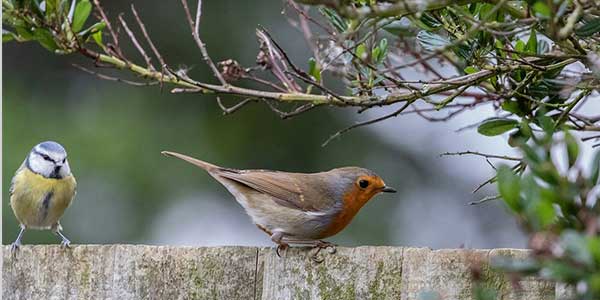
I have a new window feeder
It took the robins a year or more to tempt anything with the previous one but finally, this winter, having moved it up and down to an assortment of heights, robins eventually found it.
So did a blackbird but he could never quite work out how to land on it because, being larger than the robin, he kept bumping his head on the cover of it – the cover of it which was supposed to keep the food dry.
It was quite funny watching him. He would sit just above it on the railings, working out the best way of getting at it, cocking his head this way and that, then making several abortive jumps towards it.
He tried jumping up to it from ground level too but that didn’t work either.
Last month the plastic cracked so I sent off for this posh new one. It has a large tray, a little extra one, and soft prongs at each end to hold fat balls.
Its now in place, filled up with meal worms and other delicacies for the robin, plus the fat balls, which it also seems to like, even though the balls are in danger of turning into suet puddings in the recent rain.
I think my visiting robin is actually a pair, but it’s impossible to tell males and females apart even though I have tried hard to find any distinguishing feature, though one just seems to behave slightly differently from the other.
One or other of them found this feeder almost immediately and scoffed large quantities of worms at a time.
Now there is a regular visit from a lady blackbird, who had no trouble at all about the access, and they have been feeding alternately in a well mannered way.
Occasionally a rather handsome male blackbird drops by but he doesn’t get much of a look in. I am still waiting for the various tits to find it.
I started making notes for this article near the end of January when we had a cold spell but water was still pouring off the fields.
Come March and programmes aimed at gardeners were warning us not to use tap water to water our gardens.
It has never occurred to me to water the garden at this time of the year, but the Met people warn us that many reservoirs are still not full after last year’s drought so unless we have some really good downpours in the next few months, it doesn’t bode well for this year either.
As I write this we are in a showery spell, so fingers crossed that we will have lots more to come this spring.
All the same, this winter, and the spring so far, has been a challenge for gardeners.
In an effort to beat the drought, I, like many others, tried buying several drought resistant plants and what happened?
We had three really hard frosts and some of these haven’t survived. After all they are of Mediterranean heritage, so they are used to warm, dry conditions. It’s so hard trying to decide what to do for the best at the moment.
Yew Trees
I had always understood that the reason yew trees are so often found in churchyards was that they were planted there to keep cattle and other livestock out because all parts of yew are poisonous.
As the dead were treated with great reverence, it made sense not to encourage anything that would make a mess over the graves. Then a friend told me of a programme she had heard which offered another angle altogether.
Yews can live to a very old age and many found in churchyards are 1,000 – 1,500 years, much older than the churches that were built there. It is very difficult to age a yew precisely because there is no definite series of annual growth rings after about 400 years and it continues to resurrect itself constantly by means of side shoots.
The resultant stump in the midst of all these shoots is often hollow but filled with rotting wood caused by a fungus The older they get the greater their girth and there was one that was recorded in Leeds in Kent that was so large that it was said to have been lived in by a family of gypsies in the the hollow interior. I suppose the rotting wood made quite a comfortable mattress. However, the size of its girth isn’t always an indication of age. A naturalist in the 1980’s found one measuring more than 14 feet but concluded that it couldn’t have been more than 230 years old because the gardens it was growing in were designed by Capability Brown and the yew was recorded as being planted then.
It seems that my original theory about yews keeping livestock at bay is way off the mark. Hundreds of years ago, when there were far more trees around, it is
much more likely that church sites were deliberately chosen near yews because it was thought that they would help to shelter the building and successive church
authorities added more later to continue the tradition..
Having said that, yews are a definite danger to all living creatures, even the leaves and bark. Yet these same toxins can be extracted to provide certain
treatments for breast cancer, so the tree has probably saved more human lives than taken them. Strange isn’t it?
By the way, I know I’ve said it before, but should you get the impression that I have a brilliant fund of knowledge, let me assure you that I haven’t.
I just have some good reference books and on this occasion I have a most helpful one all about British trees. Since this is an edition of The Caundler which is all about books, this one is called ‘Out of the Woods’ by Will Cohu and it is full of fascinating facts about British trees from recognition to tree-biography to what it calls ‘tree gossip’. It is a fascinating book and one that is useful to have around if trees mystify you as much as they do me.