
Think back to the summers of not long ago.
When the buzzing and hum of insects and the strident sound of grasshoppers and crickets were the background orchestra of a warm, summer’s day that accompanied you through fields and lanes and gardens.
They were the sounds of my childhood, when my parents took us for hikes into the countryside.
Later, they were with me on walks on the downs of Surrey, on the moors of Devon and our lanes here, and in our gardens wherever we were.
More recently, on my rides on Genevieve they accompanied me.
But has that wonderful sound gone for ever?
The lack of them was the subject of a rather sad programme I heard on the radio one day recently.
Genevieve and I headed down Rowden Lane and searched amongst the hogweed, meadowsweet and nettles on the verges for some trace of them.
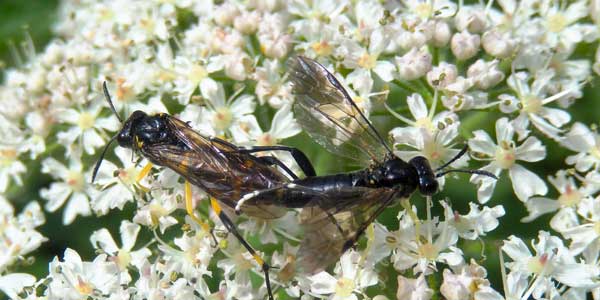
Hogweed usually hosts many insects and I found at least a few heads that were doing just that.
There was even some noise around them from the buzz of flies of all shapes and sizes, including the iridescent green familiar one, wild bees and bee flies, small wasps, hover flies and small beetley things, hardly any of which I recognised and which made me realise that I know nothing at all about the insect world.
I wonder whether I have enough years left to even begin to learn what’s what and which is which?
The only one I really knew in Devon was the orange coloured soldier beetle, but there were certainly none of those around.
However, I was greatly heartened by Janie telling me that she had seen soldier beetles AND heard grasshoppers amongst the wealth of wild flowers she had found on one of her many walks near here.
Down the lane that is my hunting ground, the abundance of creamy, fluffy heads of meadowsweet and flowering nettles had benefited from all the rain we have had.
They had looked miserable in the dry weather for the past few years, unlike the hogweed which will put up with almost anything.
The lovely, meadowsweet, with its dual scents of sweet almond and cucumber, should be host to no end of small beetles whilst the nettles provide everything a tortoiseshell butterfly could wish for on which to lay its eggs.
Here’s a bit of useless information – meadowsweet was once strewn on floors in front of a bride so that the air would smell sweet before her for all her life.
Purple Loosestrife, Vetch and Chicory
On a small patch of ground that is slightly higher than that around it, there was a patch of purple loosestrife.
This surprised me as I had thought it only grew in ditches or beside water, but on talking about it with Janie, I learned that they have a long root, so it probably has its feet in water, even in its present position.
There are several varieties of vetch out, largely purple but one yellow, which is the meadow vetchling, a plant that scrambles through meadow lands and rough grass.
The purple one is a common vetch – such a shame any flower has the prefix, ‘common’ because that word conjures up the wrong image for something as lovely as a flower.
This one also scrambles around and can grow quite tall, even attempting to clamber through hedges at times.
I was also delighted to see two short, stumpy blue chicory heads by the bridge.
I had feared that the tall, sturdy plant of it that had delighted me over the past few years, had vanished with the floods, but it seems to have left a good inheritance behind.
Great pleasure from a hare
Just as I got to the entrance of a field where I usually turn round, a hare suddenly ran past the inside of the gate and up the edge of the field.
That really did give me a great deal of pleasure.
Several people had told me that they had seen them, but they are on foot and walking over fields, unlike Genevieve and me who have to stick to the roads.
I watched it until it was out of sight, and I was once again mesmerised by the speed at which it travelled. I love them and am pleased that they are increasing in numbers, but I wonder whether farmers share my enthusiasm?
I believe they can seriously damage cereal crops.
Nearer to home, I have unwelcome neighbours.
A pair of magpies seem to have taken a liking to the trees in my neighbour’s garden and are paying visits to mine. These birds, although handsome in their glossy black and white livery, are large and hassle small birds.
They also have a nasty habit of raiding nests and dining on fledglings.
The woods are the place for these raiders, not gardens and I keep my fingers crossed that something will make them realise this.
One of the carers who visits me is Australian and thought I was very lucky to have them as they have such a beautiful song.
When I pointed out that I don’t find their harsh cackle in the least beautiful, she played me an Australian one on her phone.
No comparison – it was like hearing the difference between a nightingale and a frog.
I think most of my house martins have fledged.
I see little flocks of them swirling round and round the house, in training to feed and fly the long distance to warmer climes.
The trouble is, there is often a second brood, which is always a bit worrying, because I’m never sure whether they will be strong enough to make the journey.
Forgive me, but I’m now going into rant mode on something that has been puzzling and infuriating me for some time.
As large numbers of our small song birds are decreasing at such an alarming rate, isn’t it time to do something more about one of the avoidable hazards they face on their way back to countries such as ours for the summer, that of netting and trapping?
This was widely practised across Europe, but a law to prohibit this was passed and agreed by the European Union, but is continually broken by Malta, France, and Italy, to name just three.
They seem to do it for various reasons; Malta, for instance, because it uses small birds as decoys for larger ones.
The countries involved are responsible for the trapping of so many of the birds that are declining rapidly, including thrushes, turtle doves, plovers and nightingales, and it makes no sense to me at all that they are allowed to get away with it. If a law is signed and agreed, why can’t it be upheld?
Ending on a positive note
I have slow worms in my garden, and a multitude of frogs of all sizes and ages, newts and lots of insects and butterflies and an assortment of birds, all
buzzing or flying around, presumably enjoying it as much as I do.
Good.
I must be doing something right!